How to size an office switch: PoE budget and uplink capacity
Adding cameras can leave a wireless access point short of power even when the switch has spare ports. The uplink can also run out of capacity independently. Before buying, count the ports, calculate the Power over Ethernet (PoE) budget and estimate traffic to the rest of the network.
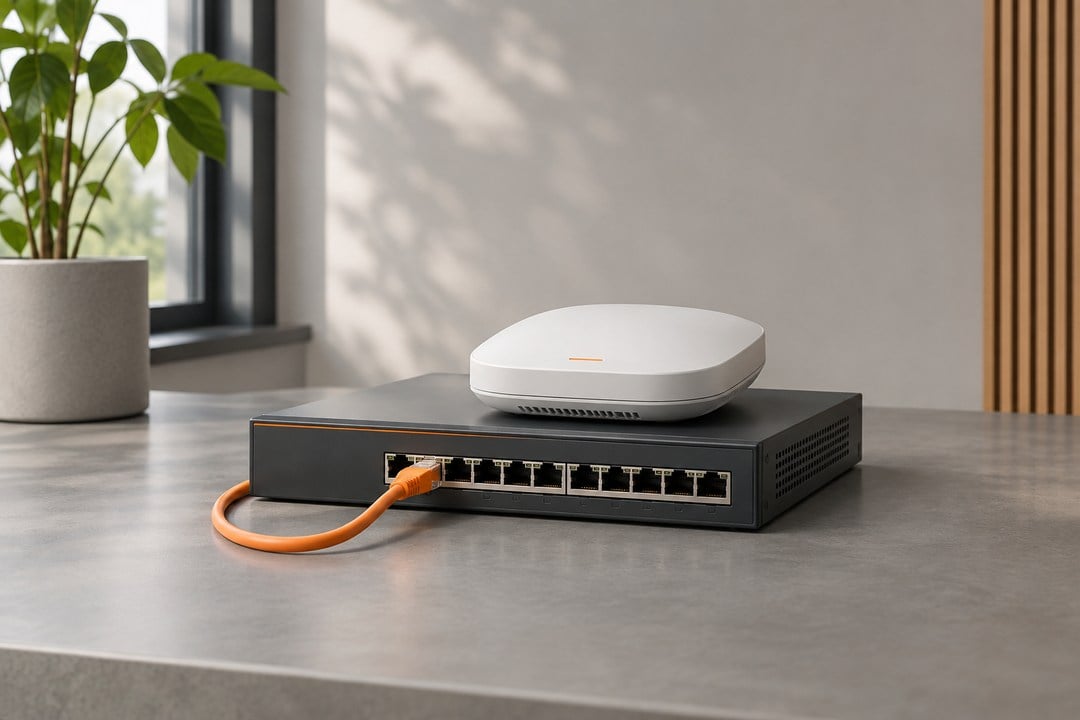
Count the devices on each switch
Map access points, IP phones, cameras and workstations to wiring closets. Record each device’s required port speed and power standard. Some access points disable features when less power is available. Specify which features you need and include planned expansion.
Can the switch power everything at once?
Check the PoE standard and available power for each port. Add the allocations on the switch side and compare the total with the budget for the actual power supply configuration. One camera’s instantaneous draw is a poor basis for sizing a fleet. If operation must continue after a power supply fails, calculate that case separately.
Estimate traffic that crosses the uplink
Measure both directions during busy periods. For a new office, model simultaneous activities such as video calls and system image downloads. Traffic between devices on the same switch and VLAN may stay local, whereas transfers to a server on another floor use the uplink.
Test the proposed configuration
Power the expected devices simultaneously and reproduce a representative workload. Record per-port allocations, total power and uplink utilisation in both directions. Check an outcome users care about, such as call quality or file transfer time. Schedule any agreed failover test in a maintenance window.
What to compare in supplier quotes
| Parameter | Inputs | What to compare |
|---|---|---|
| Power per port | Requirements of one access point. | Supported standard and power available on that port. |
| Total switch budget | Sum of port allocations and agreed headroom. | Available budget with the quoted power supplies. |
| Server room uplink | Concurrent traffic and its direction. | Link capacity during normal operation and after a link failure. |
Worked example: one office floor
Eight access points allocated 30 W each and four cameras allocated 15 W each require 300 W. Two additional access points raise the requirement to 360 W. For data, an observed 850 Mb/s plus a concurrent 300 Mb/s transfer in the same direction totals 1.15 Gb/s, exceeding a nominal 1 Gb/s uplink.
Checklist
- The port inventory records location, speed and power requirements.
- The budget matches the quoted power supply configuration.
- Concurrent traffic assumptions come from measurements or a documented scenario.
- The test covers the target load and agreed failure scenario.
Sources and documentation
Related solution
Review the scope and prepare your questions for an initial discussion.
Explore LAN and Wi-Fi designBefore you start a project
What to check before upgrading a server room
Map service dependencies, peak load and the conditions for a safe cutover.

How to choose Microsoft Teams Rooms equipment and compare AV quotes
Compare equipment, management costs and licences before fitting out several rooms.
Let’s talk about your IT.

IT systems integrator based in Łódź, Poland. Hardware, infrastructure and custom software for businesses.